AI Household Account Book / Final Tax Return

“AI Household Ledger & Tax Return” Powered by ChatGPT
This is a tool that automatically generates data usable for tax returns simply by managing your income and expenses like keeping a household ledger.
You can record daily income and expenses, link credit card statements, or even upload all your accumulated receipts at once at the end of the year.
Any input method is fine!
AI Household Ledger & Tax Return is a highly convenient tax return data creation tool that can be integrated with Excel.
AI Household Ledger & Tax Return
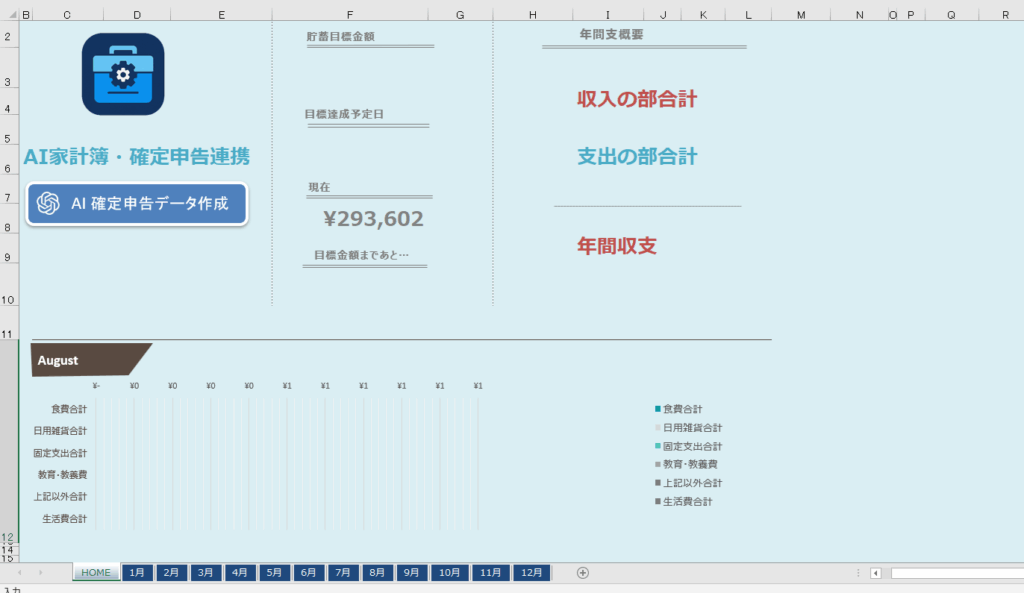
The AI Household Ledger & Tax Return tool allows daily household ledger entries to be reused for tax return data.
By leveraging AI, it automatically generates tax-related data, which is often complicated and time-consuming to prepare.
List of Data Required for Tax Filing
To file a tax return smoothly, it is important to organize various types of information such as income, expenses, family structure, and deductions in advance.
Below is a categorized summary of the main data handled by the AI Household Ledger & Tax Return tool.
Some items can be automatically linked from household ledger data via AI, while others require manual input for proper data generation.
Basic Information (Taxpayer & Family)
Since this information affects deductions and dependent eligibility, be sure to prepare accurate details for yourself and your family.
- Name, date of birth, address, phone number, email address
- My Number (for yourself and dependents)
- Occupation / business type
- Family structure (spouse, children, parents living together, etc.)
- Number of dependents, whether they have income, and living arrangements
Income-Related Data (AI-Linked from Household Ledger)
All income should be organized based on certificates received from employers or clients.
- Employment income: Withholding slip (payment amount, income tax withheld, social insurance premiums, etc.)
- Business income: Sales details, invoices, payment records
- Miscellaneous income: Side income (e.g., YouTube, Mercari, note, etc.)
- Real estate income: Rental income, management fees, common service fees
- Dividends & stocks: Dividend income, capital gains/losses (annual transaction reports from brokerage firms, etc.)
- Pension income: Public pensions, corporate pensions, iDeCo, etc.
Expense & Cost Data (AI-Linked from Household Ledger)
If you have a business or side job, organizing deductible expenses allows for accurate income calculation.
- Transportation, communication, supplies, meeting expenses, rent, etc.
- Fixed assets (PCs, cameras, vehicles, etc.): purchase date, amount, useful life
- Credit card statements (if business-use cards exist)
- Images or scanned data of receipts
Deduction-Related Data
For deductible expenses, ensure accurate records based on official certificates.
- Social insurance payment certificates (national pension, health insurance, etc.)
- Life insurance / medical insurance premium deduction certificates
- Earthquake insurance deduction certificates
- Medical expense receipts and statements
- Donation receipts (e.g., hometown tax donations)
- Income information of spouse and dependents
- Payment certificates for small business mutual aid, iDeCo, etc.
Housing & Asset-Related Data
If you have purchased a home or have a mortgage, the following data is also required:
- Mortgage balance certificates
- Real estate registration certificates
- Real estate purchase/sale contracts, acquisition costs, transfer expenses
- Business-use ratio and depreciation information for assets such as cars or motorcycles
Tax & Payment-Related Data
Reviewing taxes paid in the previous year and any prepayments will make calculations smoother.
- Previous year’s income tax and resident tax payments
- Withheld tax amounts (from withholding slips)
- Consumption tax (for taxable businesses: sales tax and purchase tax amounts)
- Prepaid tax amounts (receipts or records of payments made)
Electronic Filing (e-Tax) Data
If you plan to file electronically, prepare the following information in advance.